
The Truth About the Lost Book of Jasher
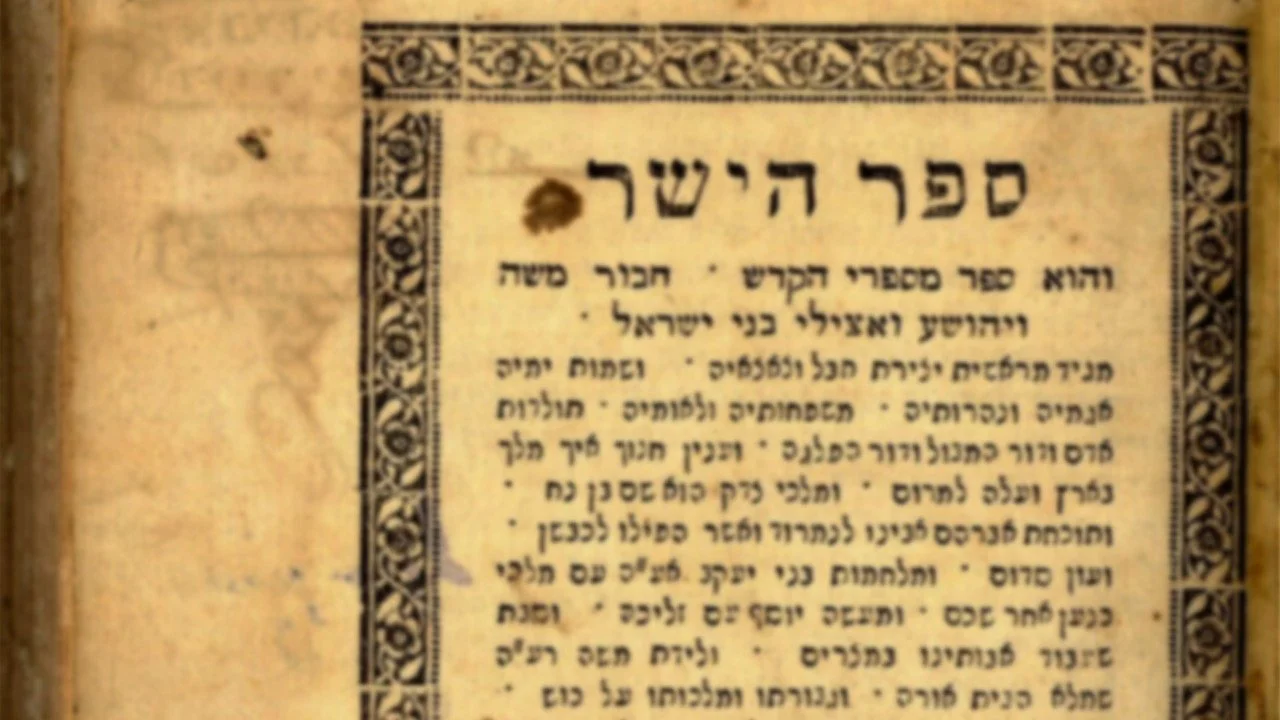
The Bible mentions several books that have been lost to history.[1] One of these is the Book of Jasher, meaning “one who is upright.”[2] Over the centuries, this book has sparked much curiosity. Some today even argue that it has been rediscovered and ought to be included in the Bible. This article explores what we know about the Book of Jasher and evaluates claims that it has been rediscovered.
What is the Book of Jasher?
The Bible cites the Book of Jasher in at least two passages. One reference appears in Joshua 10:12–13, following Joshua’s command for the sun and moon to stand still, after which the text states, “Is this not written in the Book of Jasher?” It is also referenced in 2 Samuel 1:19–27, which records David’s poetic lament over the deaths of Saul and Jonathan. Duane L. Christensen suggests there could be a third reference in 1 Kings 8:12–13, which includes Solomon’s words spoken at the dedication of the temple. Although the Hebrew Bible does not mention the Book of Jasher in this passage, the Septuagint does.[3]
What was the Book of Jasher? Scholars such as Cyrus Gordon point to similarities between the biblical quotations of Jasher and some Mediterranean epics. Based on these parallels, Gordon concludes that the Book of Jasher consisted of poetic accounts describing Israel’s battles and achievements.[4]
Other scholars, like Edward Greenstein, contend that the book should not be limited to one specific classification and suggests instead that its contents reflected a broader range of genres.[5] Greenstein also suggests that the Song of Moses (Deut. 32) may have been included in the Book of Jasher and perhaps even contributed to its name. The song includes the word “upright” (ישר, yasar) near the beginning (Deut. 32:4), and since biblical songs were often named after a key word within them, the Song of Moses may have been known as “The Upright.” If so, when it became part of a larger anthology, the entire collection could have come to be called “The Book of the Upright.”[6]
In any case, scholars generally agree that the Book of Jasher was some compilation of poems or songs. That is the extent of what can be known based on the passages preserved in Scripture. Since the remainder of the work has been lost, we have no way of determining anything else about its contents.
Has the Book of Jasher Been Found?
In recent years, books bearing the name “Jasher” have gained popularity, and some Internet personalities claim that one of these modern works is the real Book of Jasher mentioned in the Bible. One such person has praised this Book of Jasher as “quite useful in helping us to understand what is being said in the Bible and provide[s] many added details for the stories contained within it.”[7] The Eth Cepher, an amateur Bible translation (and I’m using the term “translation” very loosely), even includes this version of Jasher among its collection of “books of sacred scripture.”[8]
Having access to the actual Book of Jasher would be remarkable indeed. Yet despite what is often claimed on the Internet, the reality is that none of the modern works called Jasher are the same “Book of Jasher” mentioned in Joshua 10:13 and 2 Samuel 1:18. No serious scholar believes that the original Book of Jasher has ever been found, and there are good reasons why these later writings are considered forgeries.
For instance, the specific book called “Jasher” included in the Eth Cepher is, in fact, a Hebrew text first published in Venice, Italy, in 1625 by Joseph ben Samuel. This so-called Book of Jasher retells and elaborates upon many of the early biblical stories, beginning with Adam and concluding with the death of Joshua.[9] In most cases, when people speak of a supposedly rediscovered Book of Jasher, ben Samuel’s publication is the work they are referring to. Ben Samuel wrote a preface to this edition of Jasher in which he told elaborate stories of how this purportedly ancient text had survived to his day, though it remains unclear whether “these legends were the figment of Joseph ben Samuel’s fertile mind or whether they were transmitted to him.”[10] In spite of these doubtful claims of antiquity, the book gained considerable popularity and was widely circulated. Eventually, this version of the Book of Jasher was translated into English and published in New York in August 1840 under the direction of Mordecai Manuel Noah.[11]
Past scholars have argued that this so-called Book of Jasher was written in the eleventh or twelfth centuries CE,[12] though a few recent scholars have argued that Joseph ben Samuel himself may have been the author.[13] In any case, there is no evidence that this work is the same Book of Jasher mentioned in the Bible. In fact, there is much evidence to the contrary. Since the Book of Jasher is cited in Joshua 10:12–13, the authentic Jasher text must predate the writing of Joshua. Yet the so-called Book of Jasher under examination contains numerous linguistic and historic anachronisms that preclude such an early date. Moreover, it omits material that the Bible attributes to Jasher and contradicts the biblical account. Consider the following five observations.
First, this so-called Book of Jasher uses the term פרתמים (“nobles”),[14] which is a Persian loanword found only in Persian-period texts such as Esther and Daniel (Est. 1:3; 6:9; Dan. 1:3).[15] Additionally, it frequently uses the Latin loanword אפריקה (“Africa”),[16] which in early Jewish usage denotes the Roman province centered on Carthage[17] that was established in 146 BCE.[18] Neither the Persians nor the Romans had contact with Israel at the time of Joshua, so the existence of Persian and Latin loanwords in ben Samuel’s text clearly indicates that it was written long after Joshua’s time.
Second, this so-called Book of Jasher also contains historical anachronisms. It describes peoples such as the Franks dwelling in France along the Seine, and the Hungarians, Bulgars, and Pechenegs near the Danube.[19] Yet these groups did not settle in those regions until between the fifth and tenth centuries CE.[20] If the author of this Book of Jasher was writing in the time of Joshua, how could he be referencing medieval European tribes that arose nearly two millennia later?
Third, near the end of this so-called Book of Jasher, the text states: “the rest of Joshua’s doings, and his wars with the Canaanites, and his admonitions and instructions, and all his commandments unto the children of Israel, and the names of the cities which the children of Israel possessed in his days, behold they are recorded in the book of the words of Joshua.”[21] The author is clearly referring readers to the biblical Book of Joshua as an already-existing written work. If this so-called Book of Jasher refers to Joshua as an already-existing text, then Joshua must predate it. It cannot both cite the Book of Joshua and at the same time be the source that Joshua cites in Joshua 10:12–13.
Fourth, this so-called Book of Jasher ends with Israel’s conquest of Canaan and does not contain the lament over Saul and Jonathan in 2 Samuel 1:19–27, which is a passage the Bible explicitly attributes to the original Book of Jasher. How can this book be the real Jasher if it does not even contain all of the content the Bible ascribes to Jasher?
Fifth, this so-called Book of Jasher contradicts the Bible repeatedly. For instance, it claims that Abram left Haran at the age of sixty-five,[22] but the Bible states that he was seventy-five (Gen. 12:4). It claims that Jacob fled to the house of Eber, the son of Shem,[23] but the Bible states that Jacob fled to the house of Laban, Rebekah’s brother (Gen. 27:43). It claims that the Red Sea was divided into twelve sections,[24] but the Bible describes it being split into two (Exodus 14:21–22).
These five points clearly demonstrate that this Book of Jasher is not the lost work mentioned in the Bible.
Another Fraudulent “Book of Jasher”
Another text claiming to be the lost Book of Jasher appeared in London in 1751, published by the deist Jacob Ilive.[25] On its title page, Ilive claimed that he had translated it into English from a Hebrew scroll allegedly discovered in Gazna. As Arthur Chiel explains:
Ilive’s The Book of Jasher consists of thirty-seven chapters which begin with the Creation story and extend to the rule of “Jasher, the son of Caleb who judged Israel in Shiloh.” Jasher is represented as an adjutant of Moses, along with Joshua. But even a casual reading of this work reveals the book’s real purpose: the rejection of Revelation. Jethro emerges as the “founding father” of Israel’s law code. It is Jethro who convokes Moses and the seventy elders on Mt. Sinai where he instructs them about the governance of Israel. Here, then, was the real intent of The Book of Jasher: to challenge the credibility of the Pentateuch and to diminish altogether the role of Moses.[26]
Ilive’s book was quickly and widely recognized as a fabrication, and authorities sentenced him to three years of imprisonment for the fraud.[27] Nevertheless, Ilive’s Book of Jasher has endured and has been republished in various forms over the years.[28] However, like the first so-called Book of Jasher examined above, this work is certainly not the lost biblical book.
Conclusion
The Book of Jasher mentioned in Scripture was most likely a collection of ancient poems or songs, yet beyond the brief quotations in Scripture, we know nothing further about its contents. The later works that carry the name Jasher contradict the Bible and display obvious linguistic and historical anachronisms. The original Book of Jasher has not survived, and the texts circulating today under that title are not the book cited in Joshua and 2 Samuel.
[1] In addition to the Book of Jasher (Josh. 10:13; 2 Sam. 1:18), the Hebrew Scriptures refer to several now-lost works, including the Book of the Wars of the LORD (Num. 21:14); the Book of the Acts of Solomon (1 Kings 11:41); the Book of the Chronicles of the Kings of Israel and the Book of the Chronicles of the Kings of Judah (passim in 1–2 Kings); the Book of Nathan the Prophet and the Book of Gad the Seer (1 Chron. 29:29; cf. 2 Chron. 9:29); the Prophecy of Ahijah the Shilonite and the Visions of Iddo the Seer (2 Chron. 9:29); the Book of Shemaiah the Prophet and the Story of Iddo the Seer (2 Chron. 12:15; 13:22); the Book of Jehu son of Hanani (2 Chron. 20:34); the Acts of Uzziah (2 Chron. 26:22); the Sayings/Chronicles of the Seers (2 Chron. 33:19); and the laments for Josiah composed by Jeremiah (2 Chron. 35:25).
[2] Duane L. Christensen, “Jashar, Book of,” in Anchor Yale Bible Dictionary, ed. David Noel Freedman et al., vol. 3 (New York: Doubleday, 1992), 646.
[3] Duane Christensen, “The Lost Books of the Bible,” Bible Review 14, no. 5 (1998): 24–31.
[4] Cyrus H. Gordon, “Ugarit as Link between Greek and Hebrew Literatures,” Revista degli Studi Orientali 29 (1953): 161–169.
[5] Edward L. Greenstein, “What Was the Book of Yashar?” Maarav 21.1–2 (2014): 26–28.
[6] Greenstein, “Yashar,” 33–34. For other scholars who have suggested that the Song of Moses was part of the Book of Jasher, see Greenstein, “Yashar,” 39n18, 34n47.
[7] Rob Skiba, Genesis and the Synchronized, Biblical-Endorsed, Extra-Biblical Texts (King’s Gate Media, 2013), ix.
[8] Stephen Pidgeon, “87 Books of Sacred Scripture,” Cepher Publishing Group, accessed January 18, 2026, https://www.cepher.net/87-books-of-scripture.aspx.
[9] See Arthur Chiel, “The Mysterious Book of Jasher,” Judaism 26:3 (1977), 371: “In total, the Book of Jasher is a richly embellished story of the early part of Biblical history, from Adam to Joshua. Its author had resourcefully collected sundry legends and tales connected with events and persons of the early period and had woven them together with a skillfully constructed narrative.”
[10] Chiel, “Jasher,” 368.
[11] Chiel, “Jasher,” 367.
[12] Chiel, “Jasher,” 372.
[13] Carmela Saranga, “Between the Book of Jissipon and the Book of Jasher,” in The Jews in Italy: Their Contribution to the Development and Diffusion of Jewish Heritage, ed. Yaron Harel and Mauro Perani (Boston: Academic Studies Press, 2019), 129.
[14] Sefer HaYashar (midrash), Genesis, Miketz 2; 6; 9; Vayechi 3.
[15] HALOT, s.v. “פַּרְתְּמִים”.
[16] Sefer HaYashar (midrash), Genesis, Vayechi 7; Exodus 2, 4–11, 17, 34.
[17] Jastrow, s.v. “אַפְרִיקִי (אַפְרִיקָא)”. The Book of Jasher uses both אפריקה and אפריקא, but אפריקה appears more frequently.
[18] Jean-Paul Morel, “The Transformation of Italy, 300–133 B.C.: The Evidence of Archaeology,” in The Cambridge Ancient History, 2nd ed., vol. 8, Rome and the Mediterranean to 133 B.C., ed. A. E. Astin et al. (Cambridge: Cambridge University Press, 1989), 493.
[19] Sefer HaYashar (midrash), Genesis, Noach 15.
[20] Florin Curta, Southeastern Europe in the Middle Ages, 500–1250 (New York: Cambridge University Press, 2006).
[21] Sefer HaYashar (midrash), Book of Joshua 10.
[22] Sefer HaYashar (midrash), Genesis, Noach 28. Some translations say “fifty.” See Mordecai Manuel Noah, ed., The Ancient Book of Jasher: Referred to in Joshua and Second Samuel (New York: M. N. Noah & A. S. Gould, 1840), 43.
[23] Sefer HaYashar (midrash), Genesis, Toldot 7.
[24] Sefer HaYashar (midrash), Exodus 51.
[25] Chiel, “Jasher,” 372.
[26] Chiel, “Jasher,” 373.
[27] Chiel, “Jasher,” 373.
[28] Morton D. Paley, “William Blake, Jacob Ilive, and the Book of Jasher,” Blake: An Illustrated Quarterly 30, no. 2 (Fall 1996): 53.















About David Wilber

David Wilber is an author, Bible teacher, and CEO of Pronomian Publishing LLC. He has written several books and numerous theological articles, with his work appearing in outlets such as the Christian Post and the Journal of Biblical Theology. David has spoken at churches and conferences across the nation and has served as a researcher and Bible teacher for a number of Messianic and Christian ministries…

From the very beginning, human beings have been quick to blame others rather than take responsibility for their own wrongdoing. In this week’s Torah portion, Bereshit, we see how Adam and Eve’s response to their sin reveals a tendency that continues to plague humanity today. As followers of Yeshua, we are called to break this cycle of blame-shifting through humility, repentance, and personal responsibility.