
Pseudepigrapha: Are 1 Enoch, Jubilees, and Jasher Inspired Scripture?
The pseudepigrapha are writings falsely attributed to biblical figures or presented as ancient biblical-era works. Well-known examples include 1 Enoch and the Book of Jubilees; later works, such as the books published under the name “Jasher,” may also be described as pseudepigraphal. Ancient pseudepigraphal works were read and valued by some Jews in the Second Temple period, but they were not part of the Jewish Scriptures recognized in Yeshua’s day or treated as Scripture by the New Testament authors.

Apocrypha vs. Pseudepigrapha: Two Different Questions
The Apocrypha are books like the Wisdom of Sirach and 1 and 2 Maccabees: Jewish writings from the centuries before Yeshua that some Christian traditions include in their Old Testament. Whether they belong there has been debated in church history, and nobody disputes that. As Roger Beckwith observes, their inclusion "was not done in any agreed way or at the earliest period, but occurred in Gentile Christianity, after the church's breach with the synagogue."
The pseudepigrapha are a different collection. 1 Enoch claims to contain the visions of Enoch, seventh from Adam. Jubilees presents itself as revelation dictated to Moses on Sinai by an angel. The books sold today as “Jasher” claim to preserve the lost book cited in Joshua 10:13. None of these was ever part of the Jewish canon. 1 Enoch and Jubilees were preserved as Scripture in the Ethiopian Orthodox tradition, while the modern books called “Jasher” were not. This page is about these pseudepigraphal works, and particularly the three books the Eth Cepher has most successfully promoted as “sacred scripture.”
How We Know the Canon Was Closed Before Yeshua
The Judaisms of the Second Temple era—including Christians—did not consider the pseudepigrapha (such as Jubilees, 1 Enoch, etc.) to be "Scripture." Four points support this contention.
First, the books that make up the Tanakh are referred to in the New Testament and other Second Temple era Jewish literature as the Torah, Nevi'im, and Ketuvim—that is, the Law, the Prophets, and the Writings. This threefold "canon" of Scripture even appears in the New Testament. For instance, in Luke 24:44-45, Yeshua makes direct reference to this threefold canon and defines it as "the Scriptures." This means that Yeshua the Messiah gave this canon divine affirmation as the Scriptures.
Second, this threefold designation was used to define the canon of Scripture long before the time of Yeshua and the apostles. Ben Sira, the author of the Apocryphal book, the Wisdom of Sirach, had a grandson who translated his grandfather's writings into Greek around 130 BCE. This translator wrote his own prologue to the translation, which makes reference to the threefold shape of the Old Testament canon. Thus, by the time this prologue was written, this idea of a closed canon of Scripture already existed. As far as we know, no manuscript or historical evidence indicates that the pseudepigraphical literature, such as 1 Enoch or Jubilees, was ever accepted as part of this threefold canon of Scripture. Neither the Greek Septuagint nor the Hebrew Masoretic texts included the pseudepigrapha in their sets.
Third, in a passage from Against Apion, written in the 90s CE, the first-century Jewish historian Josephus wrote that a defined Hebrew canon already existed by his time. Josephus limits these inspired books to a certain number: twenty-two. Five books, he says, are the books of Moses. 13 are the prophets. And the remaining 4 he says are hymns to God and precepts for human life. The Jewish canon today has 24 books, which matches the contents of our protestant canon of 39 books; Josephus' count combined Ruth with Judges and Lamentations with Jeremiah. No scholar believes that any book that isn't already part of the Old Testament canon we have today would have been part of Josephus' first century canon.
Fourth, not even the Qumran community, which certainly revered books like 1 Enoch and Jubilees, included this literature in their canon. As Beckwith shows, the Essenes used the standard three divisions of the canon and one of the standard counts of the canonical books, and grouped their own pseudepigrapha in a separate appendix.
Since we know what writings the Jews considered canonical, and we know that Yeshua referred to those writings using the standard Jewish terminology of the canon without ever disputing the contents, we have every reason to conclude that Yeshua was in complete agreement with the Judaisms of His day in regard to the extent of the canon. Thus, Messiah's definition of Scripture excludes the pseudepigrapha.
Go deeper
- VideoThe Biblical Canon Was NOT Decided at the Council of Nicaea
- TopicWhat Is Pronomian Theology?, the reading of Scripture underneath all of this
"Revered" Is Not "Scripture"
Nobody disagrees that the pseudepigrapha were read, quoted, and highly valued among the Second Temple Judaisms, including the early Christians. The question is whether anyone considered them Scripture, and the evidence says no.
The clearest test case is Qumran. The community that preserved the Dead Sea Scrolls held 1 Enoch and Jubilees in high regard and still did not count them among the Scriptures. The closest modern parallel is the oral Torah in Orthodox Judaism: believed to carry divine authority, passed down from Sinai, and yet no Jew confuses it with Scripture. Qumran valued the pseudepigrapha in something like that way. The New Testament authors did not go even that far, because much of what 1 Enoch teaches directly contradicts what they wrote.
The same distinction settles the Jude question below. Biblical authors quoted material nobody would call inspired. Paul quotes pagan Greek poets. The psalmists borrow vocabulary from Egyptian and Mesopotamian literature. A pastor today can quote a popular movie because it illustrates a true point without believing the movie is inspired.
The Book of Jubilees
Jubilees, sometimes called Little Genesis, is a rewriting of Genesis and the first half of Exodus. It presents itself as revelation given to Moses during his forty days on Sinai: an angel reads to him from "celestial tablets" that lay out history in fifty jubilees of forty-nine years each, from creation to Israel's settlement in the land. It is a fascinating window into Second Temple Judaism and worth reading for that. The trouble starts when it is made into something more.
When was it written?
It was not written by Moses. The scholarly consensus places Jubilees in the second century BCE, and the book fits that setting. Its strong opposition to nudity "as the nations uncover themselves" (Jub 3:31) answers a controversy that arose only after the Greek gymnasium opened in Jerusalem in 175 BC. Its names for the classes of giants come from the Book of Dreams, a section of 1 Enoch that alludes to a battle fought in 164 BCE. It draws on Isaiah, Amos, and the Psalms. Every one of those sources was written long after Moses.
Why it is not Scripture
Jubilees was never in the canon, as the section above shows, and Josephus, the Sirach prologue, and even Qumran all exclude it. Strikingly, the book may testify against itself: Jubilees 2:23 counts twenty-two acts of creation and twenty-two generations from Adam to Jacob, and later Greek writers who quote the verse include twenty-two sacred books in the same list. If that reading reflects the original text, the author of Jubilees did not consider his own book on par with Scripture.
More decisive is that Jubilees contradicts the Bible. Its biggest conflict is its attitude toward the Gentiles: God himself, it says, created spirits to rule the nations and lead them away from him (Jub 15:30–32); Jews may not eat with Gentiles (Jub 22:16); Gentiles may not keep the Sabbath (Jub 2:31). Scripture says the opposite. God calls the nations to repent, worship him, and keep his Sabbaths (Isaiah 56:1–8), sends Israel to disciple them (Matthew 28:19–20), and in Acts 10–11 orders Peter to a Gentile's table. Jubilees also condemns the moon-based calendar the Torah uses for the festivals (Jub 6:36), adds Sabbath rules the Torah never gave (Jub 50:8), declares all of Lot's descendants doomed to annihilation (Jub 16:9), which would take in Ruth the Moabite, King David, and the Messiah himself, and makes fasting on the Sabbath a capital crime (Jub 50:12–13), which both Moses and Yeshua broke in their forty-day fasts.
Its 364-day calendar cannot even work. With no way to add a month, the festivals drift earlier every year; within thirty years Sukkot arrives before there is any harvest to gather (Leviticus 23:39), and eventually Passover falls in autumn and Sukkot in spring.
Go deeper
- ArticleThe Book of Jubilees is not Inspired Scripture, also published in the American Journal of Biblical Theology (2023)
- VideoThe Truth About the Book of Jubilees
- VideoSean Griffin is Wrong About the Book of Jubilees
The Book of Enoch
1 Enoch is a collection of Jewish writings from the last centuries before Yeshua, presented as the visions of Enoch, "seventh from Adam." Parts of it were found at Qumran; the Book of Parables (1 Enoch 37–71) survives only in Ethiopic. It was meaningful to certain smaller sects of Second Temple Judaism, and that is exactly what it is: a religious text of its era, not a book of the Bible.
Didn't Jude quote it?
Jude 14–15 resembles 1 Enoch 1:9, but Jude may not be quoting the book at all. He never mentions a book or scroll of Enoch, only what Enoch said, and both texts may draw on the same oral tradition. The saying itself is a midrash on Deuteronomy 33:2–3 that was likely discussed across several traditions. And even if Jude quoted the book directly, that would not make it Scripture, any more than Paul quoting Greek poets canonized them.
The passage that decides it: 1 Enoch 71:14
The Book of Parables describes a Messianic figure called the Son of Man, the Chosen One, the Righteous One, and the Anointed One: a light to the nations, seated on the throne of glory, judging mankind, receiving worship. Those who call 1 Enoch inspired read these as prophecies of Yeshua. But the book tells us who the figure is. In chapter 71 Enoch is brought to the "heaven of heavens," and the Head of Days says to him: "You are that Son of Man who was born for righteousness, and righteousness dwells on you" (1 Enoch 71:14). The words match what chapter 46 said of the Son of Man. According to the Book of Parables, the Messiah is Enoch.
Some argue that the verse is mistranslated, appealing to R. H. Charles's 1912 rendering, "This is the Son of Man." But the Ge'ez has the second-person pronoun, "you," and Charles himself admitted in his footnotes that "This is" was his own emendation. No manuscript supports it; Walck, Collins, Nickelsburg, and VanderKam all reject it. And since the Parables survive only in Ethiopic, appealing to a lost "original" is an admission that the text we have makes Enoch the Messiah. A book that names a false Messiah cannot be inspired Scripture.
Go deeper: the case
- ArticleWho is the Son of Man in 1 Enoch 71:14?
- VideoWhy the Book of Enoch is NOT Inspired Scripture
- VideoThe Truth About the Book of Enoch
- VideoThe Book of Enoch: Your Questions Answered
- VideoThe Book of Enoch is Not Scripture: A Friendly Response
- DebateDEBATE: Is 1 Enoch Inspired Scripture? - David Wilber vs. Sean Griffin
- ArticleWhy the Book of Enoch Is Not Scripture, in The Christian Post (September 2026)
Go deeper: the Son of Man in 1 Enoch 71:14
- VideoThe Book of Enoch Says Enoch is the Messiah
- VideoThe Son of Man in the Book of Enoch
- VideoR. H. Charles mistranslated 1 Enoch 71:14
- VideoTimothy Alberino is Wrong about the Son of Man in the Book of Enoch
- VideoZach Bauer is wrong about 1 Enoch 71:14 and the “Son of Man”
- VideoDoes Matthew 22:23-33 prove that the Book of Enoch is Scripture?
The Book of Jasher
The Bible mentions several books that have been lost to history, and Jasher, "the upright," is one of them. Joshua 10:12–13 cites it after the sun stands still: "Is this not written in the Book of Jasher?" 2 Samuel 1:18 cites it for David's lament over Saul and Jonathan. Scholars generally agree it was a collection of poems or songs about Israel's battles. That is the extent of what can be known, because the rest of the book is gone.
The book sold as "Jasher"
The text most people mean when they speak about an alleged "found" Jasher, the one printed in the Eth Cepher, is a Hebrew work first published in Venice in 1625 by Joseph ben Samuel and translated into English in New York in 1840. It retells the biblical stories from Adam to the death of Joshua, and it cannot be the book Joshua cites, for five reasons. It uses a Persian loanword for "nobles" found only in Persian-period books like Esther and Daniel, and a Latin loanword for "Africa," the Roman province founded in 146 BC. It describes Franks on the Seine and Hungarians, Bulgars, and Pechenegs on the Danube, peoples who did not arrive there until the fifth to tenth centuries AD. It refers its readers to "the book of the words of Joshua" as an already-existing work, so it cannot be the source Joshua cites. It ends at the conquest and never contains the lament of 2 Samuel 1, which the Bible explicitly assigns to Jasher. And it contradicts the Bible repeatedly: Abram leaves Haran at sixty-five, not seventy-five; Jacob flees to Eber, not Laban; the Red Sea parts into twelve channels, not two.
A second "Jasher" appeared in London in 1751 from the deist Jacob Ilive, who claimed to have translated a Hebrew scroll found at Gazna. Its real purpose was to make Jethro, not God, the source of Israel's law and to diminish Moses. It was quickly recognized as a fabrication, Ilive was jailed three years for the fraud, and the book has been reprinted ever since. The original Book of Jasher has not survived. The texts circulating under that title are not the book cited in Joshua and 2 Samuel.
Go deeper
The Eth Cepher
The Eth Cepher is the main reason these three books are back in circulation among believers. It is an amateur Bible translation, and "translation" is a generous word, that binds 1 Enoch, Jubilees, and the 1625 "Jasher" in alongside the Torah, Prophets, and Gospels as "books of sacred scripture." Its editors, together with a handful of internet teachers, are in the extreme minority of everyone who has ever weighed these books: no Jewish community, no Christian tradition outside some Ethiopian lists, and no serious scholar puts them in the canon. Add its non-standard transliterations of the divine names, and the Cepher is best avoided.
Go deeper
- Video5 Reasons to Avoid the “את Cepher” Bible
- ArticleWhat Is the Hebrew Roots Movement? (And Why I Don’t Identify With It), where these books and the Cepher tend to travel
"But the Ethiopian Church Has Them in Its Bible"
It does, in some lists, and it is the only Christian community that does. What that proves is less than it seems. The Ethiopian Orthodox Church holds a looser idea of canon than the West: in Daniel Assefa's words, "you have various lists and no one seems to be worried or to be preoccupied to have something definitive or normative." Emmanuel Fritsch, a scholar of the Ethiopian liturgy, would not speak of a canon at all, only of "lists of books." Not every text on those lists carries the same authority; the Gospels sit at one end and early commentaries at the other. And 1 Enoch and Jubilees appear in some lists and not others. When the Ethiopian Orthodox Holy Synod published A Short History, Faith and Order of the Ethiopian Orthodox Church in 1983, its list of the "Holy Books of the Old Testament" included neither.
Were These Books Removed From the Bible?
No. Nothing can be removed from a collection it was never in. The canon Yeshua called "the Scriptures" in Luke 24:44 was the same threefold canon the Sirach prologue knew in 130 BC and Josephus counted in the 90s AD, and 1 Enoch, Jubilees, and Jasher were not in it at any point. There was no council that took them out. The Council of Nicaea in 325 did not decide the canon at all; it addressed the deity of Messiah and the date of Passover. And the claim that the Jews suppressed 1 Enoch because it testified of Jesus has the facts backwards: the book's own Messiah is Enoch. The only "removal" in this story is the Cepher's addition.
Go deeper
How to Read These Books
Read them. Jubilees and 1 Enoch are a window into the world of Second Temple Judaism, into what some Jews believed and practiced in the time of the apostles, and they are worth reading for that historical value. We can glean real insight from extra-biblical writings, but only when we appreciate them for what they are. When we make them more than what they are, when we call them Scripture, we mishandle them and run into error. Hold them the way the New Testament authors held them: as background, sometimes as illustration, never as the Word of God.
Common Questions About the Pseudepigrapha
What is the pseudepigrapha?
Ancient writings that falsely claim authorship by a biblical character or present themselves as works from the biblical era. The best-known include 1 Enoch and the Book of Jubilees; the much later books called “Jasher” are also commonly classified as pseudepigraphal. Ancient works such as Enoch and Jubilees circulated during the Second Temple period but were never part of the Jewish canon; some, however, were preserved as Scripture in the Ethiopian Christian tradition. See how they differ from the Apocrypha.
Why is the Book of Jubilees not in the Bible?
Jubilees was written in the second century BCE, not by Moses, and every first-century source for the canon (Luke 24:44, the Sirach prologue, Josephus, even Qumran) excludes it. It also contradicts Scripture on the Gentiles, the calendar, and the Sabbath. See the Book of Jubilees.
Does the Book of Jubilees contradict the Bible?
Yes, repeatedly. It says God created spirits to lead the Gentiles away from him, forbids eating with Gentiles, forbids Gentiles from keeping the Sabbath, condemns the moon-based festival calendar, and dooms all of Lot's descendants, which would include Ruth, David, and the Messiah. Scripture teaches the opposite on every point.
Why was the Book of Enoch removed from the Bible?
It was not. 1 Enoch was never in the Jewish canon that Yeshua affirmed, and no council removed it. It survives in full only in Ethiopic, and the Ethiopian Church is the only one that has ever listed it. See were these books removed?
Did Jude quote the Book of Enoch, and does that make it Scripture?
Jude 14–15 resembles 1 Enoch 1:9, but Jude may be citing a shared oral tradition rather than the book, the wording differs, and quoting a text does not canonize it. Paul quoted Greek poets. See the Book of Enoch.
Who is the Son of Man in 1 Enoch 71:14?
Enoch himself. The Head of Days tells him, "You are that Son of Man who was born for righteousness." R. H. Charles's 1912 rendering "This is the Son of Man" was an emendation he admitted the Ethiopic text does not support, and scholars have universally rejected it. That makes 1 Enoch's Messiah someone other than Yeshua.
Is the Book of Jasher sold today the one mentioned in Joshua 10:13?
No. The common "Jasher" is a Hebrew text first printed in Venice in 1625; it contains Persian and Latin loanwords, names medieval European peoples, cites the Book of Joshua as already written, omits the lament the Bible attributes to Jasher, and contradicts Genesis and Exodus. The original was lost in antiquity. See the Book of Jasher.
What is the Eth Cepher Bible?
An amateur "translation" that binds 1 Enoch, Jubilees, and the 1625 "Jasher" into the Bible as "sacred scripture," alongside non-standard renderings of the divine names. No Jewish or mainstream Christian tradition accepts those books as canon. See the Eth Cepher.
Does the Ethiopian Orthodox Church consider Enoch and Jubilees Scripture?
Some Ethiopian lists include them and others do not; the church's own 1983 Short History, Faith and Order omits both from its "Holy Books of the Old Testament." Its scholars describe canon there as a set of lists rather than a fixed collection. See the Ethiopian canon objection.
What is the difference between the Apocrypha and the Pseudepigrapha?
The Apocrypha (Sirach, Maccabees, Tobit, and others) are Jewish books with real authors that some Christian traditions place in the Old Testament; their status has been debated in church history. The pseudepigrapha claim false authorship and were never in any Jewish canon.
The Book on the Pseudepigrapha
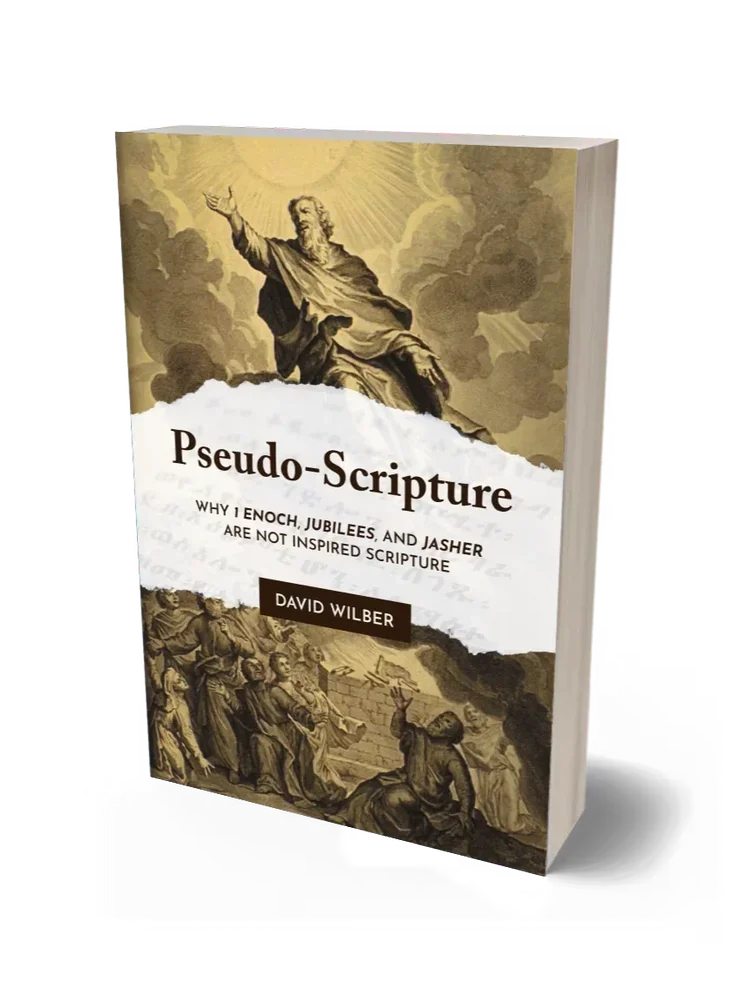 Pseudo-Scripture: Why 1 Enoch, Jubilees, and Jasher Are Not Inspired Scripture
David Wilber's full-length treatment of everything on this page: what these three books are, where they came from, why no Jewish or Christian canon ever held them, and the passages where they contradict the Bible. If someone you know is reading the Cepher, this is the book to hand them.
Further study
Resources
Where to Start
- Settle the canon question first. Watch The Biblical Canon Was NOT Decided at the Council of Nicaea.
- Then take the book you were asked about. The Book of Jubilees is not Inspired Scripture, Who is the Son of Man in 1 Enoch 71:14?, or The Truth About the Lost Book of Jasher. Each article stands on its own.
- Watch the debate. DEBATE: Is 1 Enoch Inspired Scripture? - David Wilber vs. Sean Griffin puts the strongest case for the other side next to the answer.
- Then read the book. Pseudo-Scripture for the full case in one place.