
Tucker Carlson Is Wrong About the Third Temple
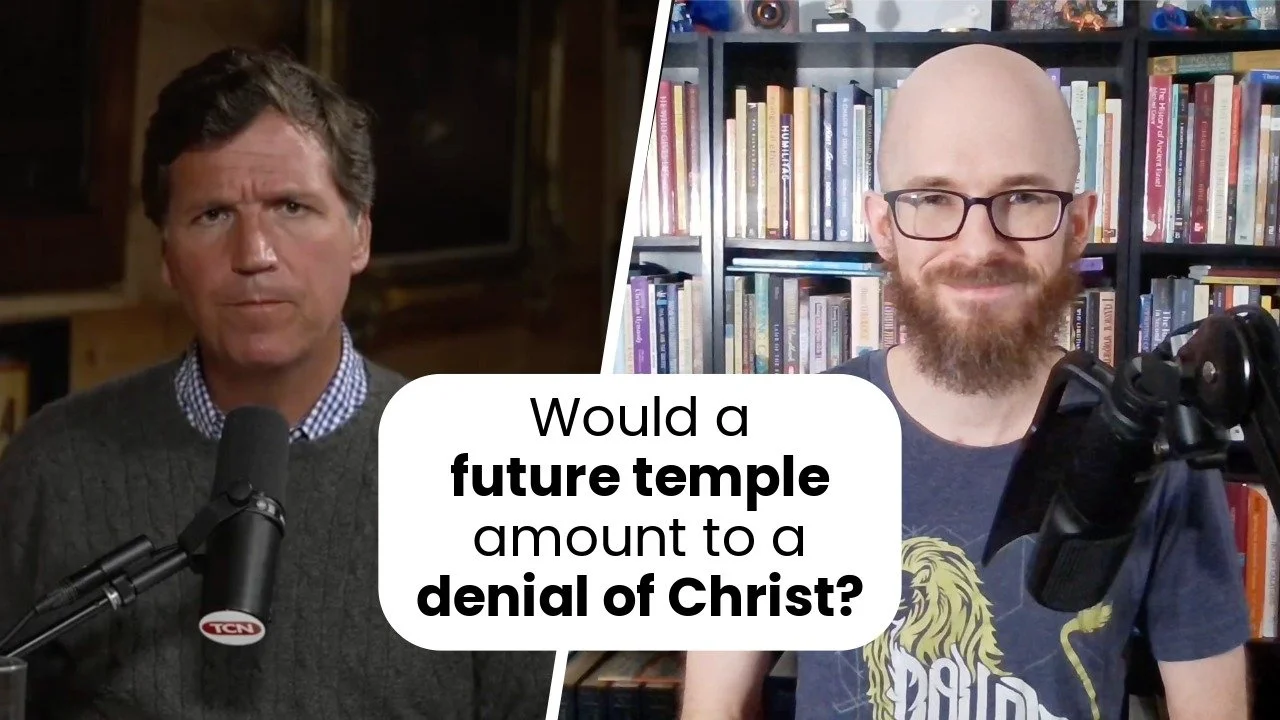
In a recent video, Tucker Carlson argued that a future physical temple in Jerusalem would amount to a denial of Christ, claiming that the Bible teaches Jesus replaced the temple entirely. He further claims that anyone who would like to see a future temple is apostate and has missed the whole point of Christianity.
But does Scripture actually support these claims? In this video, we take a careful look at what Jesus and the apostles believed about the Jerusalem temple to see whether Tucker’s argument holds up biblically.
What did Jesus actually teach about the temple? And how did the apostles treat it after the Messiah's resurrection and ascension?
Transcript
Tucker Carlson: “There are amazingly a lot of American evangelical leaders—Christian Zionists—whose main point is rebuilding the third temple. Now, how could an American Christian or any Christian call for the building of a temple whose presence—whose inherent presence—denies Christ?”
That was Tucker Carlson. In a recent video, he criticized Jews and Christians who would like to see the temple rebuilt in Jerusalem. Tucker thinks that is really bad, and he suggested that it may be the secret underlying motivation for the war with Iran. I’ll let the political people who are experts in foreign policy argue with him about that if they want. I want to focus on the theological point he is making in this video. That is, does the presence of a future physical temple amount to a denial of Christ?
Before I do that, I want to be clear that I am not out there calling for the temple in Jerusalem to be rebuilt. Contrary to Tucker’s characterization, that is not my “main point” or the main point of any Christian I know. But there is a popular view among Christians that the temple will be rebuilt in the end days before the Messiah’s Second Coming. There are also many who believe—myself included—that there will be a physical temple in the age to come after the Messiah returns. So those are two different issues.
But in any case, if the temple is rebuilt—whether before the Messiah returns or afterward—I cannot see how that would be wrong in principle. I certainly don’t think that the presence of a future Jerusalem temple denies Christ. But let’s hear what Tucker has to say.
Tucker Carlson: “Now, how could an American Christian or any Christian call for the building of a temple whose presence—whose inherent presence—denies Christ? Who said, clearly—and Christians believe this, it’s a core point of faith—'I am the temple. You want to speak to God, you speak through me.’ That’s Christianity, that’s the whole religion right there. So if you’re a Christian preacher calling for the rebuilding of the third temple, you kinda missed the whole point. That’s more than apostasy. That’s like not even knowing what the religion is about.”
According to Tucker, the idea of a future physical temple in Jerusalem is fundamentally incompatible with the religion of Jesus and the apostles. In Tucker’s view, anyone who supports rebuilding the temple is an apostate and is missing the whole point of the faith. That’s a serious accusation to make against those who profess Jesus as Lord. The problem with Tucker’s accusation is that it is unbiblical and incoherent. If Tucker is right, then Jesus and the apostles are apostates who have missed the entire point of their religion. Let me explain.
Tucker alludes to John 2:18–22, where Jesus’s body is identified as the temple. This passage is the reason that Tucker thinks that a future physical temple is incompatible with faith in Jesus. But that conclusion does not follow. It is true that Scripture describes Christ as the temple. Scripture also describes individual believers and the corporate body of believers as the temple. But none of that means that Scripture therefore rejects the legitimacy of the Jerusalem temple. How do we know? Because Jesus and the apostles fully endorsed the Jerusalem temple.
Even in John 2, just a few verses before Jesus’s body is identified as the temple, he is seen zealously defending the holiness of the Jerusalem temple, which he calls his “Father’s house” (John 2:14–17). Furthermore, throughout the Gospels, Jesus assumes normal participation in temple sacrifices at the altar in Jerusalem (Matt. 5:23–24). After he heals a leper, he explicitly commands him to go to the temple and give the offering prescribed in the Law of Moses (Matt. 8:1–4; Mark 1:40–44; Luke 5:12–14). In Matthew 23:21, he recognizes the Jerusalem temple as the place where God dwells.
Now, Jesus did prophesy that the temple would be destroyed, but that does not mean that he rejected the temple in principle. Jeremiah also prophesied that the temple would be destroyed in his own time as an act of divine judgment, yet no one thinks that Jeremiah rejected the temple or was against it being rebuilt in the future. In the same way, Jesus’s prophecy does not imply that he rejected the temple either. As New Testament scholar Michael Barber writes:
Jesus’s prediction of the temple’s end in the Gospel’s overall narrative is not the result of a rejection of cultic worship. Judgment will befall Jerusalem first and foremost because of acts of wickedness committed by its leadership. The rejection of Jesus is part of this, and it is bound up with the failure of the leaders to recognize his messianic identity—the priests fail to grasp this in the temple (Matt 21:15) and the Pharisees do not recognize him as the figure from Psalm 118 who “comes in the name of the Lord” (Matt 23:39). As in other works like Jeremiah and Daniel, the temple will not be spared in the coming cataclysm. Nevertheless, Jesus does not suggest that the sanctuary or its sacrifices are illegitimate. On the contrary, Jesus forcefully affirms their holiness.[1]
What about the apostles? Well, this is where Tucker’s theology really misses the mark. If he is correct, it would mean the apostles are apostates. Why? Because they clearly did not agree with Tucker that the Jerusalem temple and their faith in the Messiah were mutually exclusive. For example, Luke records that immediately after Jesus’ ascension, the disciples were “continually in the temple blessing God” (Luke 24:53). This statement follows directly after Luke notes that Jesus had opened their minds to understand the Scriptures and explained how the Hebrew Scriptures testified to his suffering and resurrection (Luke 24:44–49). So by this point, the disciples would have had a clear grasp of Christ’s identity, including the meaning of his claim to be the true temple. If the Jerusalem temple were somehow incompatible with Jesus being the temple, it is difficult to explain why the disciples would continue worshiping there.
As we move into the book of Acts, Luke depicts the apostles gathering at the temple literally “every day” (Acts 2:46; 5:42). Why would the disciples gather there every day if the temple were at odds with the gospel they were proclaiming? In Acts 21:17–26, decades after the Messiah’s resurrection, Paul even joins others in completing a Nazirite vow and takes part in public worship at the temple. Later, during his hearing before Felix, Paul testifies that he had fully intended to present offerings at the temple.
Following Tucker’s logic, we would have to conclude that the apostles, including Paul, were apostates who had missed the entire point of their religion. In reality, the opposite is true. If your theology contradicts the practices of the apostles, then you are the one who has missed the point.
We can see that neither Jesus nor the apostles opposed the Jerusalem temple in principle. On the contrary, they clearly endorsed it. Jesus did say that the temple would be destroyed, and it was. But again, the idea that he therefore rejected the Jerusalem temple or would oppose it being rebuilt in the future does not follow. In fact, if we take Ezekiel’s prophecies at face value, there will be a future physical temple in the age to come after the Messiah returns (Ezek. 40–48).
But what about efforts to rebuild the Jerusalem temple before the Messiah returns? Some passages in Daniel suggest that a physical temple will exist in Jerusalem in the end days and that the antichrist will desecrate it (Dan. 8:11; 9:27; 11:31). Jesus and Paul both refer to these prophecies as events that will occur in the future (Matt. 24:15–21; 2 Thess. 2:4). So, it may be the case that a temple will be rebuilt in the end days prior to the Messiah’s return.
Would such a future physical temple be a bad thing, as Tucker would have us believe? I would say no for one simple reason. If this reading of Daniel is correct and these passages refer to a third temple in the end days, the text clearly states that this temple will eventually be “desecrated” (Dan. 11:31). But in order for something to be desecrated, it must first be holy. For that reason, it does not make sense to claim, as Tucker does, that the mere presence of future temple in Jerusalem “inherently denies Christ.”
Jesus endorsed the Jerusalem temple, and the apostles did as well. They are not apostates who missed the entire point of their religion. If anyone is missing the point here, it is Tucker.
[1] Michael Barber, The Historical Jesus and the Temple: Memory, Methodology, and the Gospel of Matthew (Cambridge University Press, 2023, 110.






















About David Wilber

David Wilber is an author, Bible teacher, and CEO of Pronomian Publishing LLC. He has written several books and numerous theological articles, with his work appearing in outlets such as the Christian Post and the Journal of Biblical Theology. David has spoken at churches and conferences across the nation and has served as a researcher and Bible teacher for a number of Messianic and Christian ministries…