
R. L. Solberg's Flawed Approach to Scripture
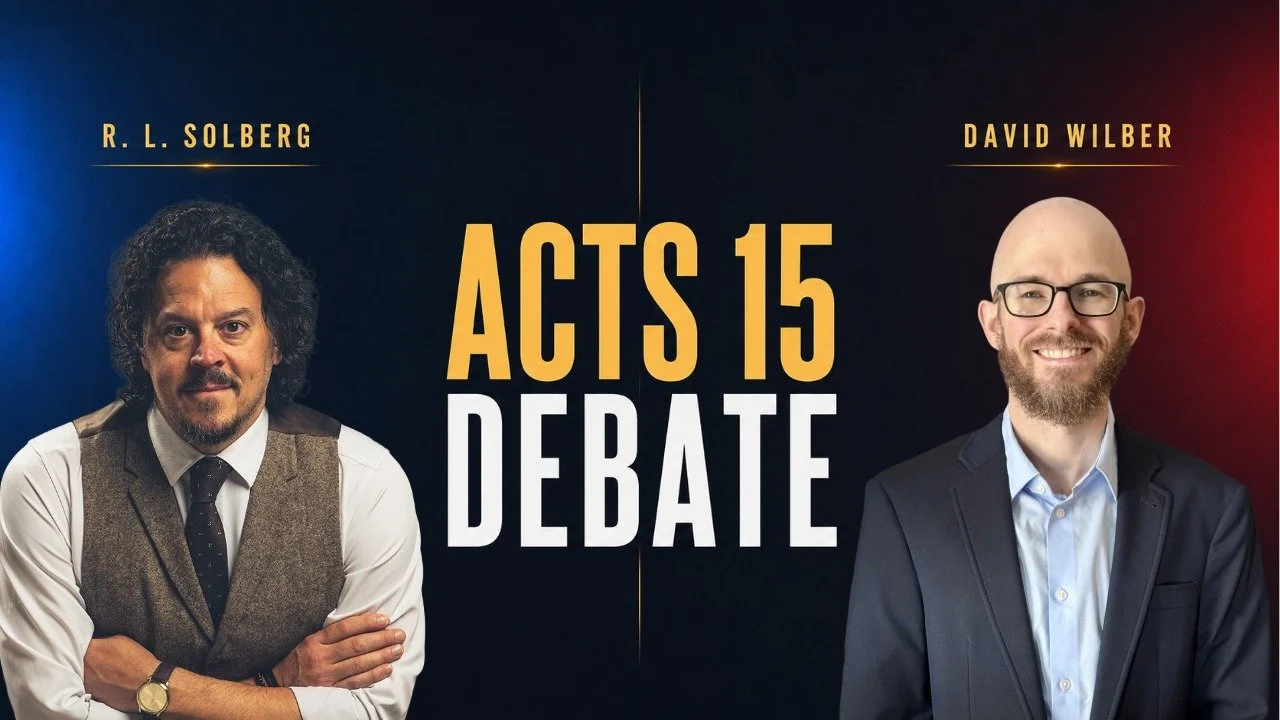
In this video, we look at R. L. Solberg’s approach to Scripture by focusing on his mishandling of Matthew 5:17–20. Rather than considering the immediate context, Solberg ignores it completely and appeals to other, unrelated texts to argue that Jesus could not have meant what he said in this passage. This eisegetical approach raises serious doubts about his reliability as a biblical interpreter.
Transcript
R. L. Solberg: “So, in Matthew 5:18, Jesus says, ‘not an iota, not a dot, will pass from the Law until all is accomplished.’ And the question is this, what did Jesus mean when he said all?”
That was R. L. Solberg, and in this video, he argues that Jesus could not have meant what he said in Matthew 5:18. I’m responding because Solberg’s treatment of this passage exposes serious problems in his approach to Scripture. And these issues are relevant as we assess whether he is a reliable interpreter or not. So, the first thing to notice here is that Solberg quotes only the second part of the verse. I’ll come back to that in a second because the immediate context explains what Jesus meant. Let’s continue:
R. L. Solberg: “Because he doesn't explain the scope of his comment. What does he mean by all being accomplished?”
Actually, he does explain the scope of his comment. You have to read the first part of the verse. Here it is: “For truly, I say to you, until heaven and earth pass away, not an iota, not a dot, will pass from the Law until all is accomplished” (Matt. 5:18).
Notice that the verse contains two temporal clauses: nothing will pass from the Law (1) “until heaven and earth pass away” and (2) “until all is accomplished.” Again, Solberg completely ignores the first clause and quotes only the second one. This is a problem because, as most scholars recognize, these two clauses are essentially synonymous.[1]
If you want to understand the scope of Jesus’s comment, read the whole verse. When will all be accomplished? When heaven and earth pass away. As long as the present heaven and earth exist, the Law remains valid. This, then, raises the question of when will heaven and earth will pass away? Scripture explicitly tells us when that will happen: it occurs in the future, after the Second Coming, when the present heaven and earth pass away and are replaced by a new heaven and new earth (2 Pet. 3:7, 10–13; Rev. 21:1; cf. Isa. 65:17; 66:22; Philo, Life of Moses 2.14). Again, contrary to Solberg’s claim, Jesus does explain the scope of his comment. It’s right there in the same verse. The fact that Solberg just ignores the first part of the verse raises questions about whether he understands basic principles of interpretation or is intentionally misleading people.
R. L. Solberg: “When Jesus said that nothing will pass from the law until all is accomplished, in what sense did he mean all? Was he referring to every last thing that has ever been prophesied, including his second coming? Well, the New Testament reveals that can't be what He meant.”
Solberg rejects a straightforward reading of Jesus’ words in this verse. He claims that Jesus could not have meant what he said. Why? As we will see, it’s because Solberg interprets other, unrelated passages outside of Matthew to be saying something different, and he allows his interpretation of those unrelated passages to override Matthew 5:18. Here is what he says:
R. L. Solberg: “That can’t be what he meant. Why? Well, the New Testament reveals that can't be what He meant. Why? Well, because there are so many examples of Old Covenant commands that have passed from the Law. For example, Hebrews 10.18, there is no longer any offering for sin. Now, the Sinai Law absolutely required offerings for sin. So, there's a change that's much bigger than a dot or iota. And Colossians 2 says that the Old Covenant feasts and food laws and Sabbaths are no longer required. Hebrews 7 and 8 say the priesthood is no longer required. Galatians 5 says circumcision is no longer required. And in John 4, Jesus himself prophesied that worship at the temple would no longer be required. These things didn't just pass away, they were fulfilled in Christ. They reached their God-ordained goal. So I believe when Jesus says, until all has been accomplished in Matthew 5:18, he's specifically talking about everything the Son of Man was sent to accomplish during his earthly ministry. I mean, the resurrected Jesus says this to his disciples in Luke 24. These are my words that I spoke to you while I was still with you, that everything written about me in the law of Moses and the prophets and the Psalms must be fulfilled. You are witnesses of these things. His disciples witnessed the fulfilling that Jesus foretold in Matthew 5, 18. The all that Jesus referred to was accomplished through his death and resurrection, which fulfilled the scriptures and inaugurated the new covenant.”
Instead of interpreting Jesus’s comment in Matthew 5:18 in its immediate context, Solberg appeals to passages from Hebrews, Colossians, Galatians, John, and Luke. Based on his interpretation of these other passages, he concludes that “all was accomplished” at Jesus’s death and resurrection. Now, to be sure, Solberg is not alone in holding this view. Andy Stanley makes the same argument in his book Irresistible, and Solberg’s overall approach to Scripture closely mirrors that of Stanley’s. But is this reading of Matthew 5:18 plausible? New Testament scholars say no. Dr. Craig keener argues that the interpretation proposed by Solberg “violates the whole thrust of the passage.”[2] Dr. J. Andrew Overman goes even future, describing this interpretation as “hermeneutical gymnastics.”[3]
Why do New Testament scholars reject Solberg’s interpretation of this verse? It is because the context precludes it, as we will see. But before we get there, I want to take a moment to point out a major flaw in Solberg’s approach to Scripture.
Once again, Solberg insists that Jesus could not have been meant that nothing would pass from the Law until heaven and earth pass away. Why? Because Solberg reads passages in Hebrews, Galatians, Colossians, and so forth, as teaching that some things have already passed from the Law. In other words, Solberg approaches Matthew 5:18 with a predetermined conclusion about what the text is allowed to say—a conclusion based on his reading of unrelated passages outside of Matthew’s Gospel. And it gets even worse than that. In his book, he actually goes so far as to change Jesus’s words in order to make the verse say something else because ultimately he acknowledges that his interpretation does not fit what the verse actually says.[4]
This is not the way to handle Scripture. We cannot use antinomian readings of unrelated passages to override the clear meaning of Matthew 5:18. Now, that is not to say that we should never look beyond Matthew’s Gospel. But our starting point as interpreters has to be the immediate context of the passage and the overall context of Matthew’s Gospel. That should be our priority, not other texts from other authors.
In his book on exegesis, Dr. Walter Kaiser warns against allowing the broader canon of Scripture to usurp the voice of the individual biblical author in our interpretation, which is precisely what Solberg does with regard to Matthew 5:18. Kaiser proposes a more responsible approach:
After we have finished our exegetical work of establishing what, indeed, the author of the paragraph or text under consideration was trying to say, then we must go on to set this teaching in its total Biblical context by way of gathering together what God has continued to say on the topic. We should then compare this material with our findings concerning the passage being investigated. But mind this point well: canonical context must appear only as part of our summation and not as part of our exegesis.[5]
If we want to rightly handle Scripture, we start by examining the passage itself within its immediate context. And when we examine Matthew 5:18 within its immediate context, contrary to Solberg, we see clearly that Jesus did mean precisely what he said. The Law of Moses will remain valid until heaven and earth pass away. That is when all will be accomplished. This is just a straightforward reading of the passage, and it fits the overall context, as we will see in a moment. Solberg’s suggestion that all was accomplished at Jesus’s death and resurrection does not work for many reasons. I will mention three.
First, as Donald Hagner points out, the most obvious problem with interpreting the second clause (until all is accomplished) as a reference to the moment Christ accomplished his work on the cross is that it “plainly contradicts the meaning of the first clause, which refers to the ongoing validity of the law until the end of the age.”[6] Again, there is a reason why Solberg ignores the first part of the verse. It is because, as Hagner has just pointed out, it directly contradicts his interpretation.
A second problem with Solberg’s interpretation of Matthew 5:18 is that it contradicts Matthew 5:17. There, Jesus explicitly commands his listeners not even to think that he came to “abolish” the Law and Prophets. The term “abolish” (καταλύω) literally means to “cause to be no longer in force” (BDAG). Several first-century Jewish texts that use the term καταλύω in verse 17 and the related term λύω in verse 19 in reference to the Law confirm this meaning.[7] In these texts, “abolishing the Law” refers to denying its authority to guide the conduct of believers. To abolish the Law means to disregard the commandments and encourage others to disregard them as well, which is an idea also reflected in verse 19: “Therefore whoever relaxes [λύω] one of the least of these commandments and teaches others to do the same will be called least in the kingdom of heaven…”
Thus, Jesus forbids his listeners from thinking that he came to invalidate any of the commandments found in the Law of Moses. Solberg’s view that Jesus invalidated the Law just a couple years later breaks Jesus’s command against thinking that he came to abolish the Law.
A third problem with Solberg’s interpretation is that it is inconsistent with Matthew 5:19. Why would Jesus warn his followers against disregarding the commandments and emphasize the importance of obeying and teaching the commandments if the Law was about to pass away in a few years? That doesn’t make sense.
Moreover, as we continue in Matthew’s Gospel, Jesus’s message is consistent. He repeatedly calls his followers to obey the commandments and rebukes the religious leaders for breaking the commandments (Matt. 7:21–23; 15:3–6; 19:17; 22:36–40; 23:3, 23). Even when it comes to commands like the Sabbath, Jesus never says that the Sabbath is about to pass away and therefore no longer matters. Instead, he goes to great lengths to explain how his conduct on the Sabbath is “lawful” (Matt. 12:12). Also, in Matthew 24, as he teaches on the coming destruction of Jerusalem and end time-events leading up to his Second Coming—obviously, long after his death and resurrection—he instructs his followers who might find themselves caught amid the turmoil of that time to pray that their flight would not occur “on a Sabbath” (Matt. 24:20). As Dr. Craig Evans writes, “By having Jesus urge his disciples to pray that the day of emergency not occur ‘on a Sabbath,’ Jesus is once again seen as upholding the Law (cf. Matt 5:17–20).”[8]
Jesus acknowledges that fleeing on the Sabbath during times of crisis is permissible to preserve life, but he makes it clear that this is not ideal. He would rather his future followers rest and experience the peace that the Sabbath day is meant to provide. If Jesus invalidated the Sabbath at his death and resurrection, why does he express concern about his followers’ ability to observe it in the future? If the Sabbath had passed away, as Solberg would have us believe, there would be no reason for Jesus to mention it in this context.
Much more could be said about the major flaws in Solberg’s interpretation, but this is enough to make the point. Again, there is a reason why scholars like Dr. Craig Keener say that Solberg’s reading violates the whole thrust of the passage and why Dr. J. Andrew Overman characterizes it as hermeneutical gymnastics. You have a serious problem when your interpretation requires you to ignore the first half of a verse, the immediate context, and the rest of Mathew’s Gospel because it contradicts your theology. You have a serious problem when you have to disregard the most relevant biblical context and go elsewhere to come up with an antinomian reading, which you then try to smuggle back into Matthew 5:18. You are not handling the Scriptures responsibly when you do that.
However, this does raise a question, because obviously Matthew 5:17–20 is not the only text in the Bible. And there are other texts could be read in a certain way that would conflict with Mathew 5:17–20. So, how do we deal with that? Well, I don’t think any of the passages that Solberg cites contradict Jesus’s teaching in Matthew. Like with Matthew 5:18, when you read each of these passages in context, you discover that the antinomian reading is just exegetically weak. It is beyond the scope of this video to go through each of them, but here are some good scholarly resources that challenge Solberg’s interpretation.
However, in general, here is one approach that I recommend: after we do our exegesis, if we later seek to harmonize seemingly conflicting passages elsewhere in Scripture, we should prioritize straightforward passages over ambiguous ones. In this case, Matthew 5:17–20 is an example of a clear, straightforward passage. As Dr. Overman writes, “Although this passage is the subject of lively controversy, it is unambiguous and does indeed command obedience to the whole Torah.”[9]
By contrast, the passages that Solberg appeals to—such as those in Paul’s letters to first-century congregations—are often more complex and address historical situations where we simply don’t have all the background information for. That means we have to dig a lot more to better understand what is going on, but this complexity makes them more likely to be misinterpreted. Peter even warns that Paul’s letters can be hard to understand and that those who are unlearned and unstable twist his letters. He continues his warning by urging his readers not to be carried away with the error of lawless people (2 Pet. 3:15–17).
In this case, then, I propose that we let the clear text of Matthew 5:17–20—together with other passages from Paul himself that clearly agree with Jesus (Rom. 3:31; 8:4; 2 Tim 3:16; cf. Acts 21:17–26) —to serve as a reference point when we examine the more difficult or ambiguous texts, such as those found in Galatians and Colossians. That does not mean that we do what Solberg does. Solberg allows his interpretation of the less clear passages to override the clear ones. Unlike him, we do not try to cancel out certain passages with other ones. Instead, what we want to do is prioritize the clear passages as a reference point so that when we encounter passages that appear to be in tension with them, that tension should invite a more careful study. When we do that, we discover that antinomian readings of those passages fail and that a pronomian reading is not only consistent with Matthew 5 but also with the immediate context of those passages on their own terms.
Friends, I hope this video has been helpful, and I encourage you to keep these points in mind as you evaluate whether R. L. Solberg is a reliable interpreter of Scripture. When your interpretation requires twisting the text to preserve a theological system, it raises serious concerns about whether God’s word is being handled responsibly and sincerely. It is important to remember that, like Andy Stanley and others, Solberg is firmly committed to the view that followers of Jesus are not required to obey God’s commandments in the Old Testament. He has devoted his entire ministry to promoting that idea. From a ministry-preservation standpoint, this commitment leaves him no room to accept the plain meaning of Matthew 5:17–20, since doing so would undermine the very foundation of his ministry. I am not accusing Solberg of being intentionally deceptive—I do not presume to know his heart—but his blatant mishandling of Scripture is concerning, and it happens to conveniently align with his overall agenda. Whether this reflects a lack of competence in basic biblical interpretation or he has some other motivation, it means he cannot be regarded as a trustworthy source on this issue.
[1] David Turner, Matthew, BECNT (Grand Rapids, MI: Baker Academic, 2008), 163. See also Donald A. Hagner, Matthew, WBC 33A (Dallas, TX: Word, 1993), 1:107-108; Matthias Konradt: “the two ἕως phrases in Matt 5.18b, d are materially identical. No iota or stroke will pass away as long as this world exists” (Christology, Torah, and Ethics in the Gospel of Matthew, trans. Wayne Coppins [Waco, TX: Baylor University Press, 2022], 78).
[2] Craig Keener, The Gospel of Matthew: A Socio-Rhetorical Commentary (Grand Rapids, MI: Eerdmans, 2009), 178.
[3] J. Andrew Overman, Church and Community in Crisis: The Gospel According to Matthew (Valley Forge, PA: Trinity Press International, 1996), 77.
[4] He writes, “Jesus meant something like: the following statement shall remain true until heaven and earth pass away: nothing will pass from the law until all is accomplished.” He offers another interpretation of Jesus’s statement in Matthew 5:18 as an additional option, again changing the words of the verse to state, “Sooner Heaven and Earth would pass away than I will fail to fulfill what the Scriptures foretold.” See Solberg, Torahism, 142–143 (Kindle).
[5] Walter C. Kaiser, Toward an Exegetical Theology: Biblical Exegesis for Preaching and Teaching (Grand Rapids, MI: Baker Book House, 1981), 82–83
[6] Donald A. Hagner, Matthew, WBC 33A (Dallas, TX: Word, 1993), 1:107
[7] For instance, 4 Maccabees 17:9 characterizes Antiochus as “the tyrant who wished to abolish [καταλῦσαι] the way of life of the Hebrews.” Moreover, in 4 Maccabees 5, there is an account of Antiochus attempting to compel the priest Eleazer to eat pork. Eleazer refuses, insisting that eating prohibited meats “is an abolishment [καταλῦσαι] of the ancestral law” (4 Macc. 5:33). Josephus similarly writes that Antiochus “put pressure upon the Jews to abolish [καταλύσαντας]their ancestral customs, leaving their infants uncircumcised and sacrificing swine upon the altar” (Jewish Wars 1.34). See Matthew Thiessen, “Abolishers of the Law in Early Judaism and Matthew 5, 17-20,” Biblica 93, no. 4 (2012), 453–556.
[8] Craig A. Evans, Matthew, NCBC (New York: Cambridge University Press, 2012), 406.
[9] J. Andrew Overman, Church and Community in Crisis: The Gospel According to Matthew (Valley Forge, PA: Trinity Press International, 1996), 77.










About David Wilber

David Wilber is an author, Bible teacher, and CEO of Pronomian Publishing LLC. He has written several books and numerous theological articles, with his work appearing in outlets such as the Christian Post and the Journal of Biblical Theology. David has spoken at churches and conferences across the nation and has served as a researcher and Bible teacher for a number of Messianic and Christian ministries…