
Did God Allow Noah to Eat Unclean Animals? (Parashat Noach)
In this week’s Torah portion, Noach (Gen. 6:9–11:32), God gives Noah permission to eat animals after the flood (Gen. 9:3). Many Christians interpret this passage to mean that Noah could eat any animal, including those later identified as unclean in Leviticus 11. But is that really what the passage teaches? When we consider the broader context of Genesis and the meaning of the underlying Hebrew terminology, there are good reasons to question this popular interpretation.
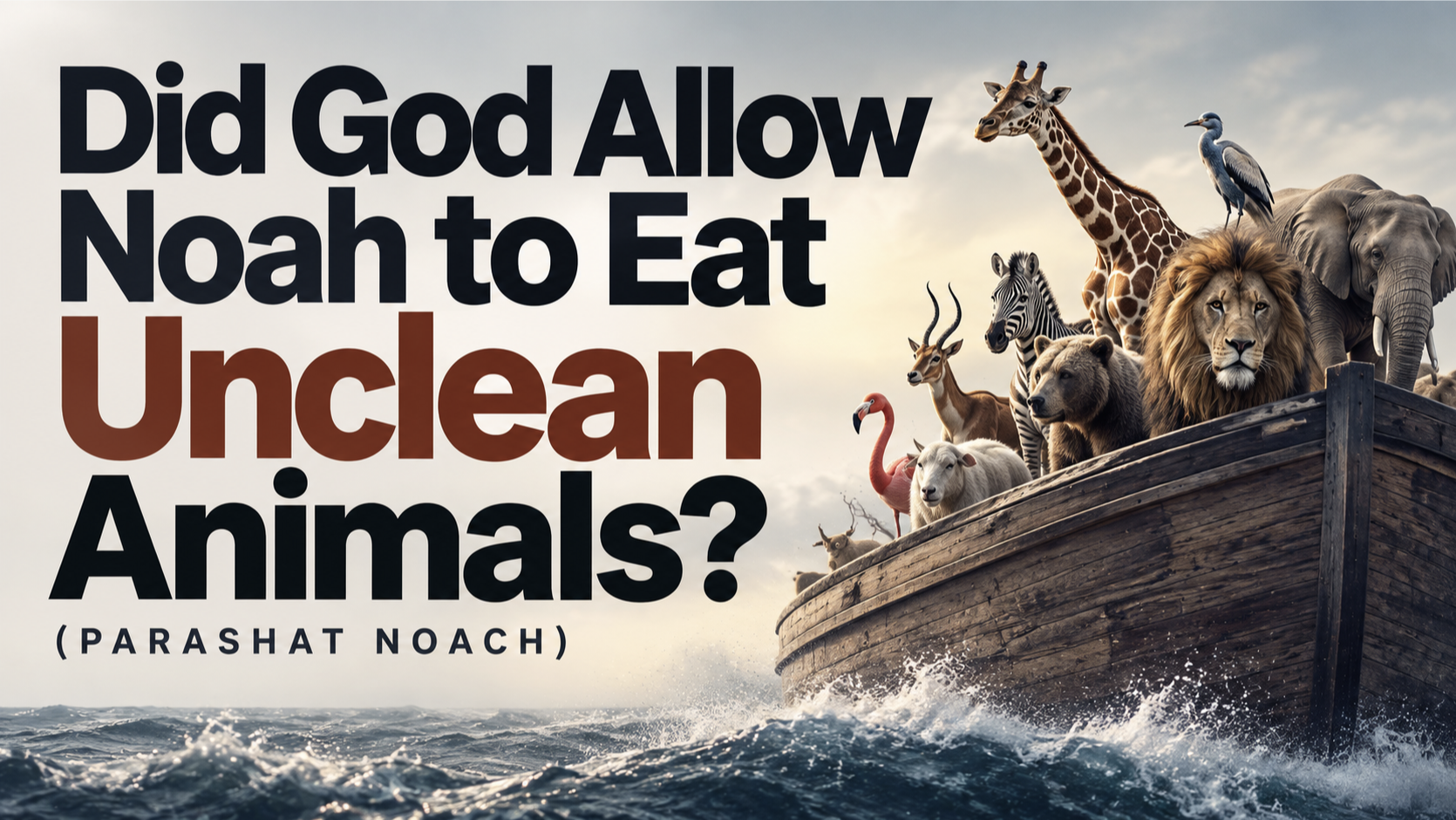
Did God Give Noah Permission to Eat Everything?
After the floodwaters receded and Noah and his family emerged from the ark, God blessed Noah and established a covenant with him. As part of this new beginning, God gave Noah the following instruction:
Every moving thing that lives shall be food for you. And as I gave you the green plants, I give you everything. (Genesis 9:3)
At first glance, this seems pretty straightforward. God told Noah that every moving thing could be food for him. Does that mean Noah was permitted to eat literally any animal, including those later designated as unclean in Leviticus 11?
Many Christians believe so. According to this interpretation, God initially allowed his people to eat unclean animals. However, when God gave the Torah to Israel at Mount Sinai, he changed the rules and prohibited the consumption of certain animals that had previously been permitted. If God’s dietary instructions changed once, why couldn’t they change again? Thus, some Christians argue that the dietary restrictions did change again after the Messiah’s death and resurrection, and therefore no longer apply to believers today.
But there are some problems with this interpretation. First, even if we grant that Noah was permitted to eat unclean animals, it doesn’t necessarily follow that believers today are exempt from God’s dietary instructions. After all, Leviticus 11 explicitly prohibits eating certain animals, and Yeshua affirmed the continuing authority of the Torah in Matthew 5:17–20. He taught that not even the smallest part of the Torah would pass away until heaven and earth pass away and everything is accomplished. He also instructed his followers to do and teach even the least of the commandments.
Furthermore, before his ascension, Yeshua commissioned his disciples to teach the nations everything he had commanded them (Matt. 28:19–20). Presumably, that would include his teaching in the Sermon on the Mount concerning the Torah’s ongoing authority.
We also see the apostle Peter appealing to the Torah when he instructs believers to be holy because God is holy (1 Pet. 1:15–16). Interestingly, one of the places where God commands his people to be holy is Leviticus 11, specifically in the context of the dietary laws (Lev. 11:44–45).
In other words, there are good reasons to believe that God’s dietary instructions remain relevant to followers of Yeshua, regardless of how we interpret Genesis 9:3.
But should we even accept the premise that Noah was permitted to eat unclean animals? I think there are good reasons why we shouldn’t.
Noah Already Knew the Difference Between Clean and Unclean Animals
One detail that often gets overlooked in this discussion is that the distinction between clean and unclean animals existed long before God gave the Torah to Israel at Mount Sinai. In Genesis 7:2, God instructed Noah to bring seven pairs of every clean animal onto the ark but only one pair of every unclean animal. Later, after the floodwaters receded, Noah offered sacrifices to God using clean animals (Gen. 8:20).
So Noah already understood that some animals were clean and others were unclean. Now, the text doesn’t explicitly say that this distinction had anything to do with food. We know that clean animals were used for sacrifices, but it’s reasonable to suggest that this distinction may also have informed which animals Noah was permitted to eat.
Old Testament scholar Gordon Wenham makes a similar observation. He notes that while the silence of Genesis 9:3 is often taken to imply that Noah could eat both clean and unclean animals, “the frequent mention of the difference between clean and unclean animals elsewhere in the story makes it problematic to assert that total freedom is being given here (7:2, 8; 8:20).”[1]
Indeed, if the narrative has already established a distinction between clean and unclean animals, why should we automatically assume that God’s statement in Genesis 9:3 disregards that distinction?
We might also consider this from a practical perspective. Noah brought only one pair of each unclean animal onto the ark. If he had started eating those animals immediately after the flood, he could have wiped out entire species before they had a chance to reproduce! On the other hand, he had seven pairs of each clean animal, providing a much larger population from which to obtain food.
Of course, this practical consideration doesn’t prove that Noah was prohibited from eating unclean animals. However, when we consider it along with the broader context of the flood narrative, it gives us another reason to question whether the phrase “every moving thing” in Genesis 9:3 should be interpreted as broadly as many Christians assume.
And there is another interesting detail in the text that makes this interpretation even more plausible.
What Does “Every Moving Thing” Actually Mean?
In Genesis 9:3, the Hebrew word translated as “moving thing” is remes (רֶמֶשׂ). Many readers naturally assume that this expression refers to every animal without exception. But according to Old Testament scholar John Walton, that’s not how the term typically functions elsewhere in Genesis.
Walton explains that remes and its related verb refer to a particular category of animals that is distinct from wild predators and domesticated livestock. He observes that the term is never “a catch-all category for all creatures.”[2] This is significant because it challenges the assumption that Genesis 9:3 grants Noah unrestricted permission to eat all animals, clean and unclean alike. Walton goes on to identify several animals that would fall within this category, including wild cattle, antelope, fallow deer, gazelle, and ibex.[3] Notice something interesting about that list? These animals are all consistent with the categories of clean animals identified in the Torah (see Lev. 11:3; Deut. 14:4–5).
Ultimately, Genesis 9:3 does not explicitly tell us whether Noah was permitted to eat unclean animals. But given the distinction between clean and unclean animals already established in Genesis and the linguistic considerations we’ve examined, there is good reason to believe that God’s permission to Noah was not as unrestricted as some assume. Instead of seeing this passage as evidence that God’s dietary standards for his people have changed over time, we can reasonably understand it as consistent with the dietary instructions later given in Leviticus 11.
[1] Gordon J. Wenham, Genesis 1–15, WBC, vol. 1 (Dallas: Word Incorporated, 1987), 192–193.
[2] John H. Walton, Genesis, NIVAC (Grand Rapids: Zondervan, 2001), 341–342.
[3] Walton, Genesis, 342.








About David Wilber
David is first and foremost a passionate follower of Yeshua the Messiah. He is also a writer, speaker, and teacher.
David’s heart is to minister to God’s people by helping them rediscover the validity and blessing of God’s Torah and help prepare them to give an answer to anyone who asks about the hope within them (1 Peter 3:15)…

From the very beginning, human beings have been quick to blame others rather than take responsibility for their own wrongdoing. In this week’s Torah portion, Bereshit, we see how Adam and Eve’s response to their sin reveals a tendency that continues to plague humanity today. As followers of Yeshua, we are called to break this cycle of blame-shifting through humility, repentance, and personal responsibility.