
Jacob is an important figure in Scripture. He is the father of the twelve tribes of Israel, and through his descendants, God’s promises to Abraham would ultimately lead to the coming of the Messiah. But Jacob wasn’t exactly a model of honesty and integrity, at least not in the early part of his life. In fact, in this week’s Torah portion, Toldot (Gen. 25:19–28:9), we find him manipulating his brother and deceiving his own father to obtain the family blessing.
How could God honor Jacob with such an important blessing when he obtained it through deception? And what can Jacob’s story teach us about God’s grace and our own journey of faith?
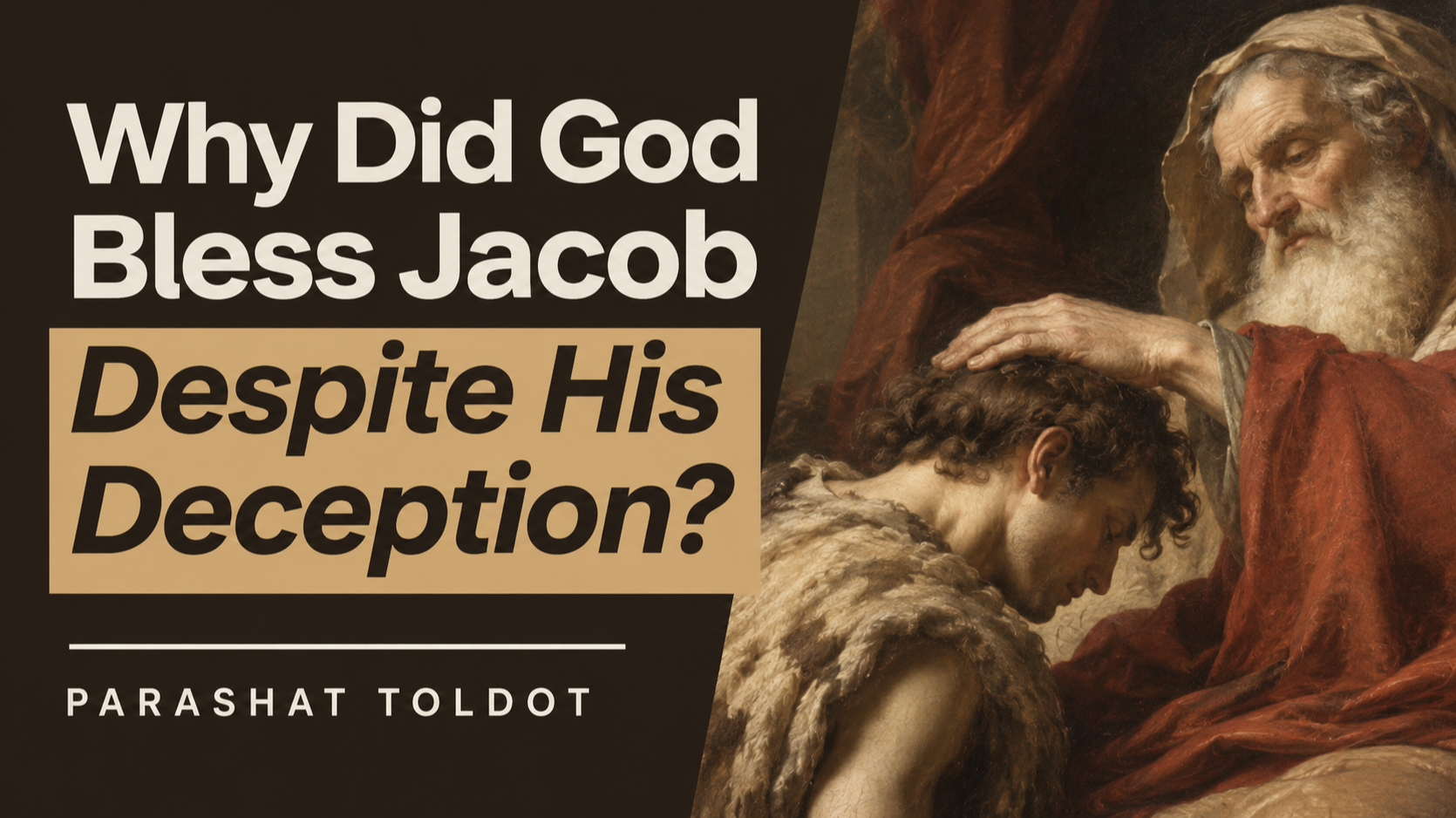
Jacob the Opportunist
Our Torah portion begins with Rebekah, Isaac’s wife, becoming pregnant with twins. The children struggle within her womb, prompting her to inquire of the Lord. God responds with a prophecy:
Two nations are in your womb, and two peoples from within you shall be divided; the one shall be stronger than the other, the older shall serve the younger. (Genesis 25:23)
So before the twins are even born, God reveals that the older son will serve the younger. When the children are born, Esau comes out first, followed by Jacob, who is holding on to his brother’s heel (Gen. 25:25–26). Interestingly, Jacob’s name comes from the Hebrew word for “heel” (aqev), and the imagery of grabbing someone’s heel can carry the negative connotation of attempting to trip someone up or get ahead at someone else’s expense.
As we will see, this imagery foreshadows Jacob’s behavior throughout the early part of his life.
For instance, in Genesis 25:29–34, Esau returns from the field exhausted and hungry. Jacob happens to be cooking some stew, and Esau asks him for something to eat. But rather than simply giving his brother some food, Jacob demands Esau’s birthright in return.
Now, the birthright was a big deal. As the firstborn son, Esau stood to receive a double portion of the family inheritance, along with the responsibility and honor of continuing the family legacy. But Esau apparently didn’t care much about his birthright. He was hungry, so he agreed to sell his birthright to Jacob for some bread and lentil stew.
Of course, Esau deserves criticism for his shortsightedness. The passage explicitly says that he despised his birthright (Gen. 25:34). But Jacob’s behavior wasn’t exactly admirable either. Rather than showing kindness to his exhausted brother, he took advantage of the situation to get something he wanted.
Contrast this with Abraham’s example in Genesis 18. When three visitors approached his tent, Abraham eagerly welcomed them and went out of his way to provide food and hospitality. Jacob, on the other hand, couldn’t even give his own twin brother a bowl of stew without demanding something in return.
Unfortunately, Jacob’s manipulative behavior doesn’t end there.
Jacob the Deceiver
In Genesis 27, Isaac has grown old, and his eyesight has become poor. He decides that the time has come to give Esau his blessing. But Rebekah overhears his plans and devises a scheme to ensure that Jacob receives the blessing instead.
Now, remember the prophecy Rebekah received during her pregnancy (Gen. 25:23). God had already declared that the older son would serve the younger. Perhaps Rebekah believed she needed to intervene to make sure God’s promise came to pass. Whatever her motivation, she instructed Jacob to disguise himself as Esau and deceive his father into giving him the blessing intended for Esau.
Interestingly, Jacob initially objects to his mother’s plan. But notice the reason for his objection:
Behold, my brother Esau is a hairy man, and I am a smooth man. Perhaps my father will feel me, and I shall seem to be mocking him and bring a curse upon myself and not a blessing. (Genesis 27:11–12)
Notice that Jacob’s concern isn’t that deceiving his father would be morally wrong. He is simply worried that the plan won’t work! He is only afraid of getting caught.
Nevertheless, Rebekah convinces him to go along with the scheme. Jacob disguises himself as Esau, approaches his father, and successfully obtains the blessing. When Esau discovers what happened, he is understandably furious. In fact, he becomes so angry that he plans to kill Jacob after their father dies (Gen. 27:41). Jacob is then forced to flee from home to escape his brother’s wrath.
So Jacob gets the blessing he wanted, but his deception tears his family apart and forces him to flee from home.
How Could God Honor Jacob’s Deception?
The blessing Jacob received wasn’t just some ordinary family inheritance. It was connected to the covenant promises God had made to Abraham. God promised Abraham that his descendants would become a great nation, inherit the land of Canaan, and ultimately become a blessing to all the families of the earth (Gen. 12:1–3; 17:1–8). These promises were passed down to Isaac and would continue through Jacob.
Indeed, the entire biblical story unfolds around these promises. As the New Testament explains, God’s promise to bless the nations through Abraham ultimately finds its fulfillment in the Messiah (Gal. 3:8, 16). So this blessing was incredibly important.
But this raises a difficult question. If Jacob obtained his father’s blessing through deception, how could God honor it? Was his dishonesty somehow justified because it helped accomplish God’s purposes?
The fact that God intended to bless Jacob does not mean that Jacob was justified in deceiving his father. And even though Esau demonstrated that he was unworthy of his birthright, that doesn’t make Jacob’s behavior righteous. We don’t need to try to justify everything the biblical patriarchs did. Scripture depicts them as flawed human beings who sometimes made terrible decisions. Jacob was no exception.
So how do we reconcile Jacob’s sinful behavior with the fact that God chose him to inherit the covenant promises? I think the answer becomes clearer when we consider the rest of Jacob’s story.
Jacob’s Encounter with God
This week’s Torah portion, Toldot, is only the beginning of Jacob’s story, which continues to unfold over the next two Torah portions.
After fleeing from Esau, Jacob travels to his uncle Laban’s household, where he gets married and builds a family. Ironically, Jacob soon finds himself on the receiving end of deception. Laban tricks him into marrying Leah instead of Rachel (Gen. 29:21–30) and repeatedly takes advantage of him throughout the twenty years Jacob works for him. Through these difficult experiences, Jacob begins to change. The man who once relied on deception to get what he wanted gradually learns to depend on God.
Eventually, Jacob leaves Laban and begins the journey back home, where he must face Esau. But the last time they saw each other, Esau wanted to kill him. And now Jacob learns that Esau is approaching with four hundred men (Gen. 32:6). Understandably, he’s terrified.
On the night before their reunion, Jacob has a mysterious encounter in which he wrestles with a man until daybreak. Jacob refuses to let go without receiving a blessing, and the man declares:
Your name shall no longer be called Jacob, but Israel, for you have striven with God and with men, and have prevailed. (Genesis 32:28)
Jacob later identifies this encounter as an encounter with God himself (Gen. 32:30).
So once again, Jacob is struggling for a blessing, but something is different this time. Earlier in his life, he obtained a blessing by disguising himself as his brother and deceiving his father. But now he receives a blessing directly from God, along with a new name and identity.
After this remarkable encounter, Jacob reunites with Esau, who embraces him (Gen. 33:4). The two brothers who had struggled against each other since they were in their mother’s womb are finally reconciled.
Jacob’s Story Is Our Story
There is a beautiful picture of salvation in Jacob’s story.
Consider how the story begins. Jacob is selfish, manipulative, and willing to deceive his own family to get what he wants. However, despite his obvious character flaws, God chooses him to inherit the covenant promises given to Abraham—promises that ultimately point to the gospel (Gen. 22:18; Gal. 3:8, 16).
Did Jacob deserve to inherit these promises because he was such a righteous person? Obviously not. God was gracious to him in spite of his unrighteousness.
And isn’t that true of us as well? Like Jacob, we have sinned and fallen short of God’s righteous standards (Rom. 3:23). None of us deserves God’s favor, yet through Yeshua, we can share in the blessing promised to Abraham and passed on through Jacob. We receive this blessing in spite of our unrighteousness because God is gracious toward us.
But as Jacob’s story shows us, God’s grace doesn’t mean that we can continue living however we want. Just as Jacob’s encounter with God marked a turning point in his life, our relationship with Messiah should transform the way we live. Indeed, immediately after explaining that salvation is by grace through faith (Eph. 2:8–9), Paul says that we were created in Messiah for good works (Eph. 2:10). In other words, good works aren’t how we earn salvation, but they are the result of a life transformed by God’s grace.
That transformation isn’t always immediate or easy. Like Jacob, we must learn to trust God rather than relying on our own schemes. We must confront our sinful habits and persevere in faith, even when doing so is difficult. Jacob’s story reminds us that God can work through deeply flawed people to accomplish his purposes. But his grace is an invitation to repent and be transformed.
So are we allowing God’s grace to change us? Are we learning to depend on him rather than ourselves?
Like Jacob, we’ve received an incredible blessing that we could never earn. Now we’re called to respond by faithfully following God and allowing him to transform us into the people he has called us to be.













About David Wilber

David is first and foremost a passionate follower of Yeshua the Messiah. He is also a writer, speaker, and teacher.
David’s heart is to minister to God’s people by helping them rediscover the validity and blessing of God’s Torah and help prepare them to give an answer to anyone who asks about the hope within them (1 Peter 3:15)…

From the very beginning, human beings have been quick to blame others rather than take responsibility for their own wrongdoing. In this week’s Torah portion, Bereshit, we see how Adam and Eve’s response to their sin reveals a tendency that continues to plague humanity today. As followers of Yeshua, we are called to break this cycle of blame-shifting through humility, repentance, and personal responsibility.